
Bun Bo Hue
“In the hierarchy of delicious, slurpy stuff in a bowl, bún bò Huế is at the very top.”
So declared celebrity chef and journalist Anthony Bourdain as he made his way through the markets of Hue, Vietnam.
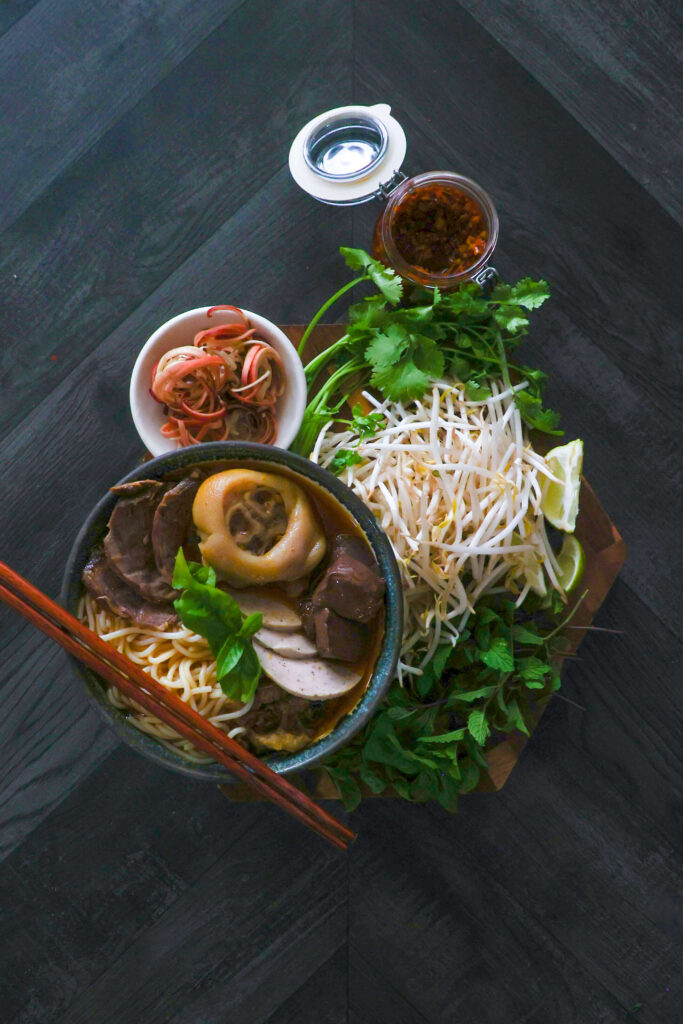
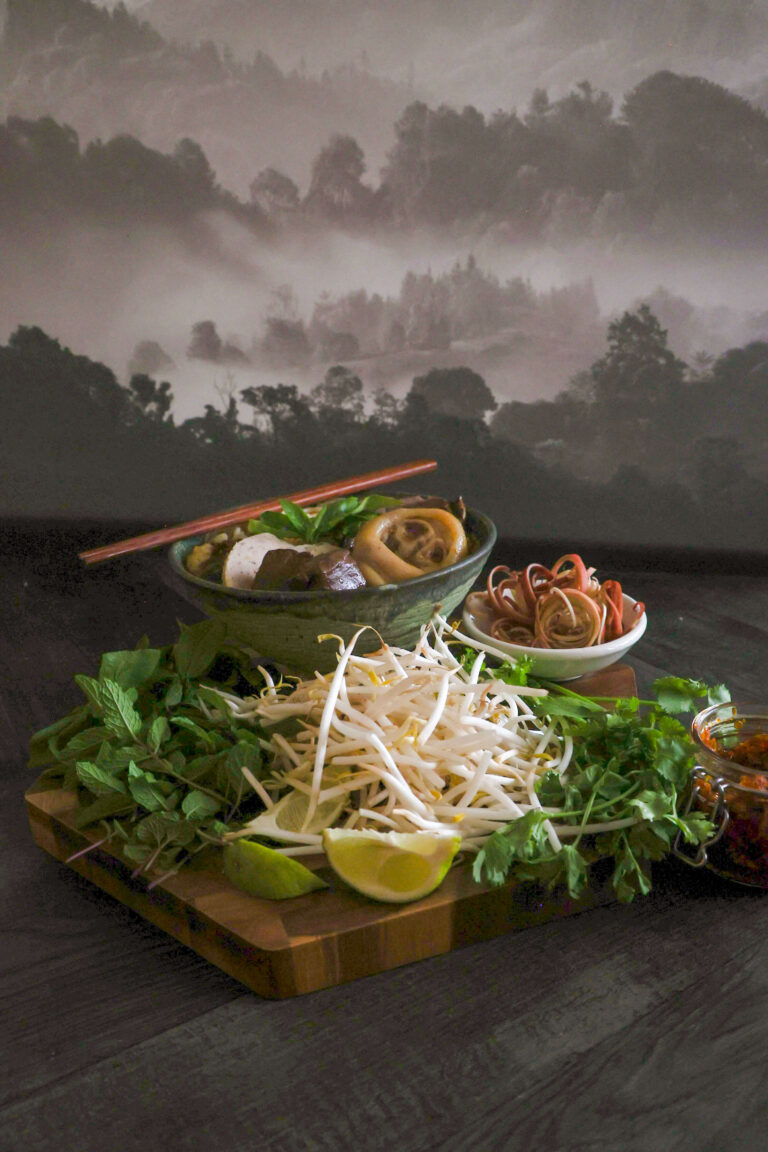
Bun bo hue, which literally translates to “Hue beef noodles,” is a dish of rice noodles in a complex and fragrant broth, topped with thinly sliced beef and Hue-style sausage, pork trotters, blood tofu, and fistfuls of herbs.
Rich, funky, and unlike any other noodle soup I’ve ever had, Bun bo hue is a masterclass in the balance between umami, heat, and tang.
Bun Bo Hue originates from the city of Hue, Vietnam’s capital from 1802 to 1945. There are many stories about the origin of bun bo hue. Some accounts say that this dish was created in the kitchens of the imperial palaces, and its specific flavour profile tailored to suit the preferences of Hue’s royalty. Others cite humble beginnings: namely, a noodle maker who, when forced to choose between abandoning her craft and exile from her hometown, took her noodle-making implements, settled in Hue, and continued to make her noodles – and later created the dish bun bo hue. Others suggest that the dish evolved from
what were originally stewed leftovers of ceremonial cattle offerings, served with sticky rice. With time, rice was swapped for rice noodles, as the latter became increasingly popular.
With all these versions of bun bo hue’s origin, one may say that the history of bun bo hue is the history of Hue. It’s no wonder that bun bo hue has been designated by Vietnam as a National Intangible Cultural Heritage.
A Note Before We Start
Making bun bo hue is not for the faint of heart.
The grocery list is a mile long and includes things like pork trotter (feet) and blood tofu. Once you gather all the ingredients, you’re looking at a half day to cook. With that said, the techniques involved are not hard.
As long as you have a heart full of love and two arms full of bones, you have what it takes to make what Bourdain declared, “the greatest soup in the world.”
Table of Contents
1. Equipment & Ingredients
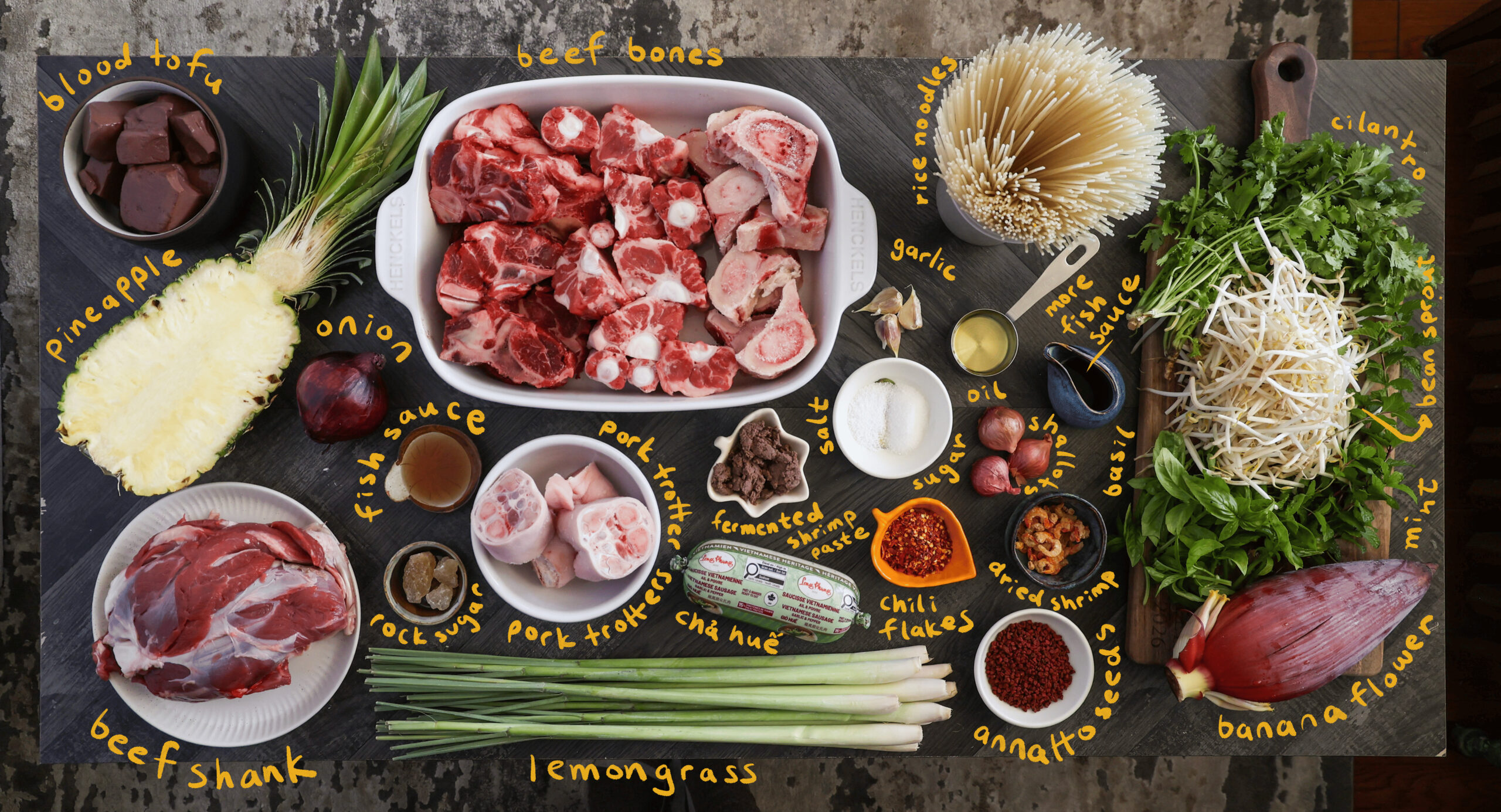
Ingredients (full list in Recipe Card)
Equipment
- Large stockpot (minimum 12 quarts) – for broth
- Small pan – for sate sauce
- Large pot – for noodles
- Fine mesh skimmer
2. Step-By-Step Guide
PART 1: START BROTH
STEP 1: Parboil meat
First, we want to parboil our meat. Parboiling just means boiling something in water for a short while, until it’s partly cooked.
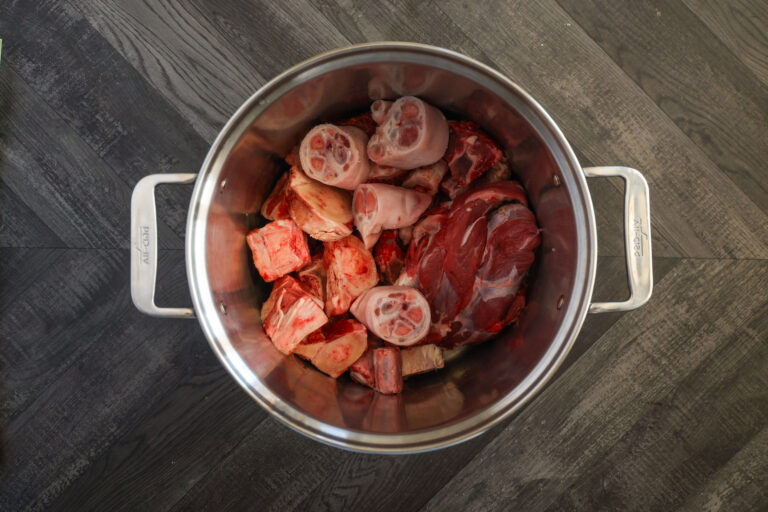
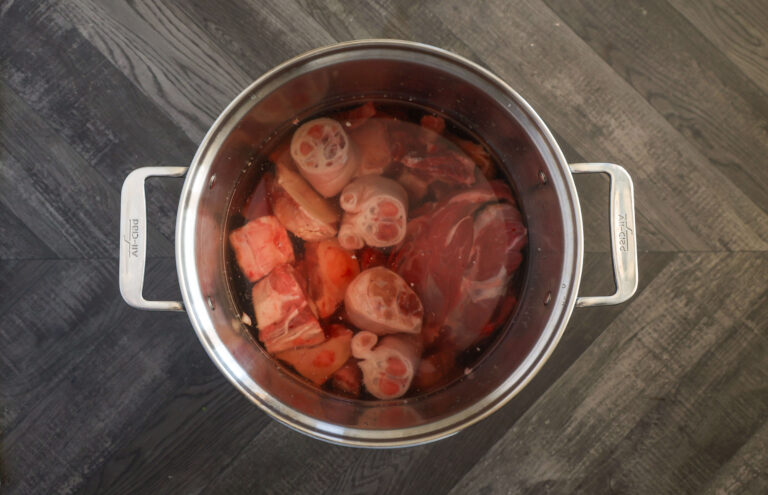
To a large stockpot, add all your meat and bones: 2 lb of beef shank, 6 lb of assorted beef bones (see FAQ: Which Bones are Best for Bun Bo Hue?), and 2 lb of pork front trotters, quartered crosswise.
Add enough water to cover everything.
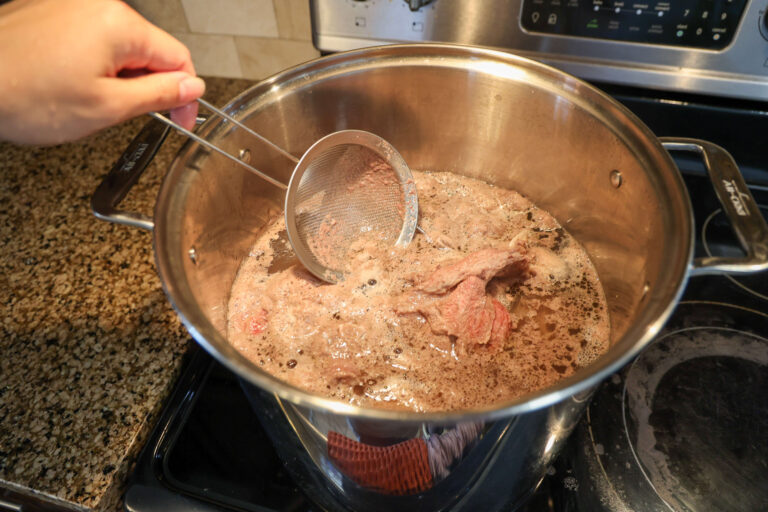
Turn heat on high and bring the pot to a rolling boil. This will take a while. Once boiling, reduce heat to medium, and boil for 10 minutes. Using a skimmer, skim the top of the water often for floating blood, fats, and other loose chunks (impurities). Discard the impurities. This skimming helps us achieve a clear end broth. Jostle the meat occasionally with a spatula to dislodge more impurities.
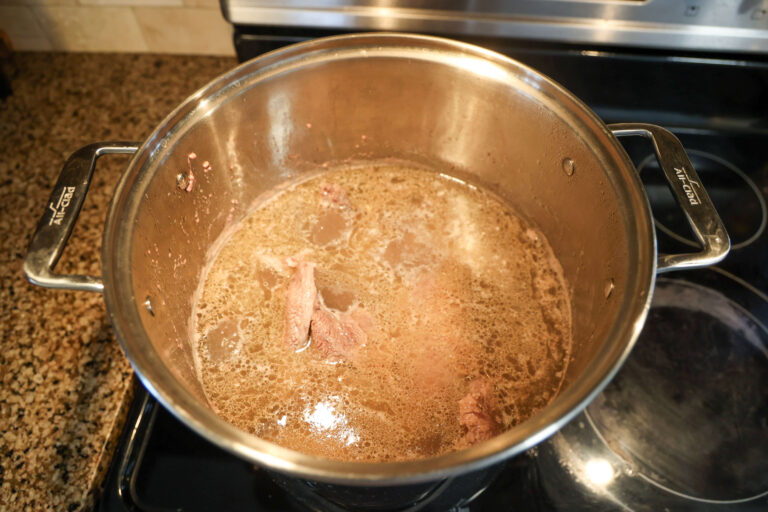
After 10 minutes, or until there’s little impurities left, remove the pot from heat, discard the water, and rinse the meat, bones, and stockpot well.
STEP 2: Boil stock
Into your rinsed stockpot, place your clean meat and bones, and just enough water to cover.
Add 2 tbsp rock sugar and ⅓ a pineapple. Wait for everything to come to a boil with the same patience as before. Then reduce heat to steady the stock at a gentle simmer.
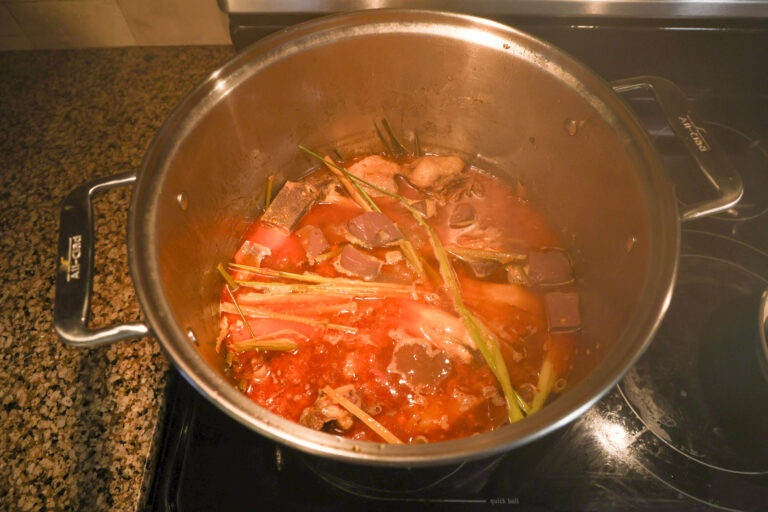
Simmer for 1-1.5 hours, until the trotters are tender but not fall-off-the-bones and the beef shank is fully cooked – you can tell the shank is ready when its juices run clear when pierced.
STEP 3: Make annatto oil
While the stock simmers, let’s make our brilliant annatto oil.
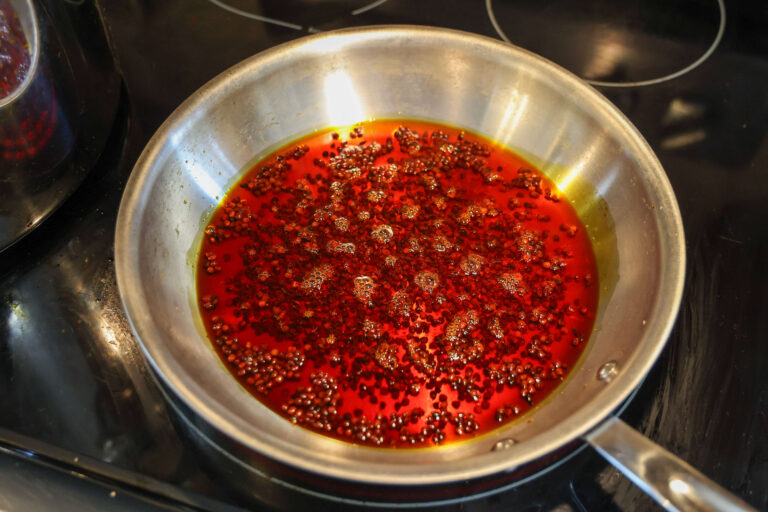
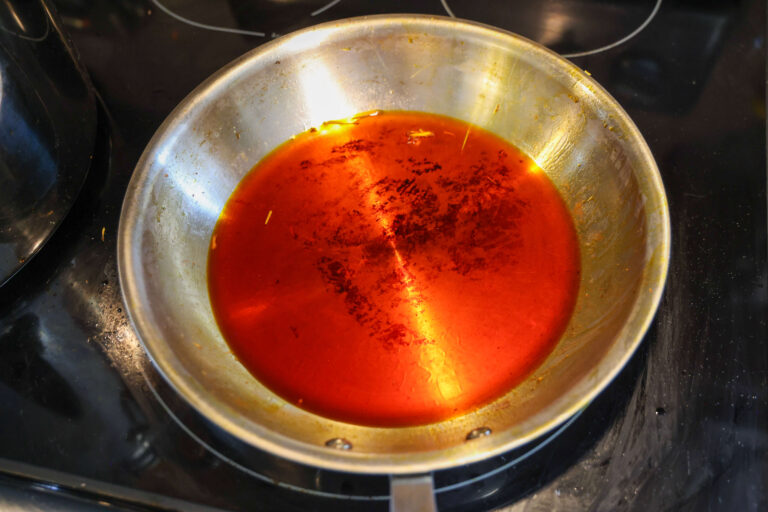
Heat ½ cup oil in a small pan on medium heat. Add 4 tbsp of annatto seeds, and saute for 2 minutes, or until oil is dark red.
Using a slotted spoon, gather and discard the annatto seeds, and spoon and remove almost all the annatto oil into a bowl for the sate sauce. Leave 1 tbsp of annatto oil in the pan for the next step.
STEP 4: Toast aromatics
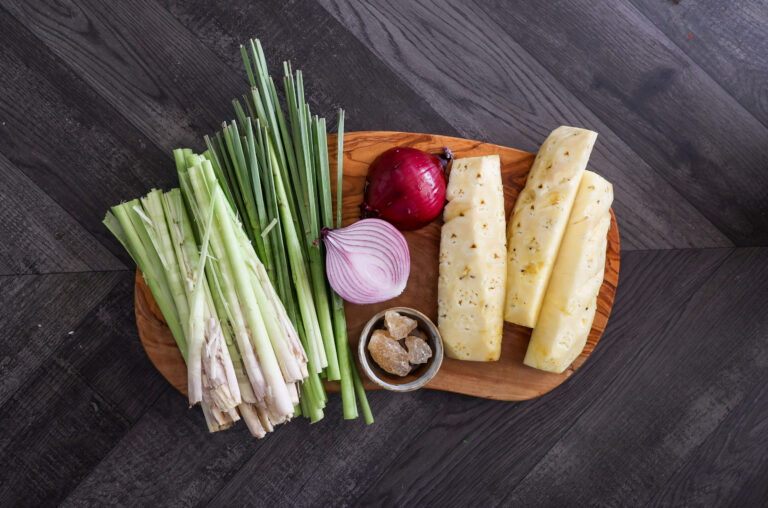
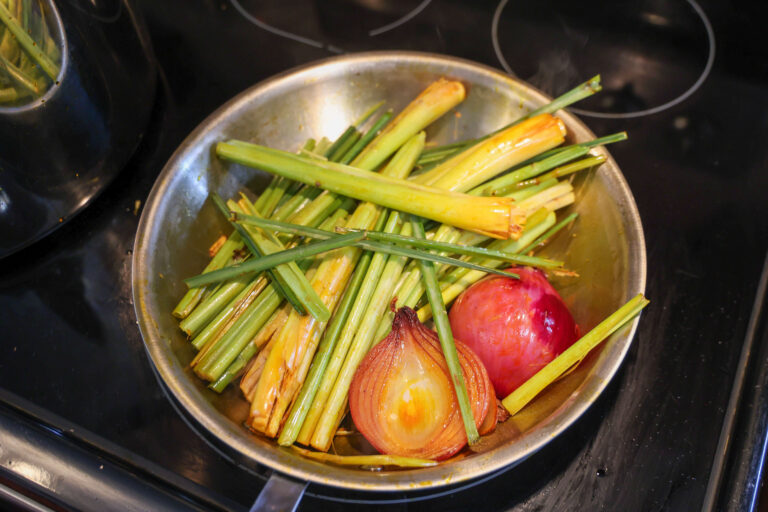
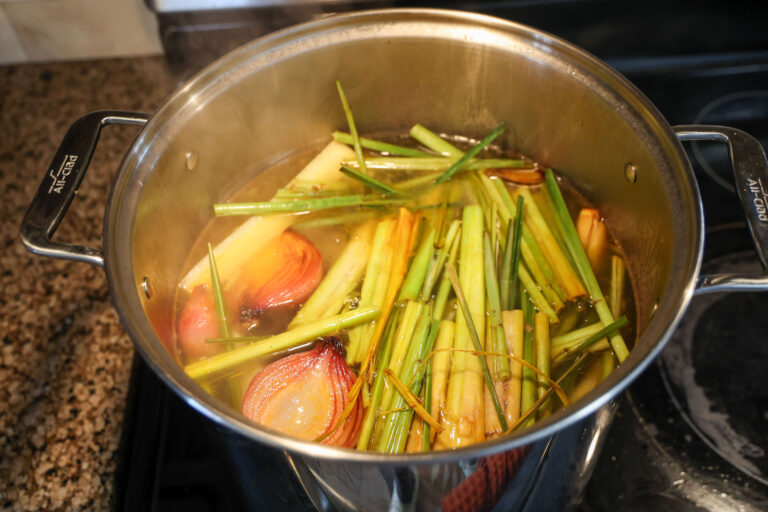
To the same pan with the 1 tbsp of annatto oil, add 8 stalks of crushed and halved lemongrass, and 1 halved yellow onion. Toast for around 3 minutes, stirring occasionally, to a good toast on different sides of the lemongrass and onion. When the onion is slightly browned and everything is quite fragrant, turn heat off and add the lemongrass and onion to the stock.
Continue to simmer the broth per STEP 2.
STEP 5: Remove trotters and shank
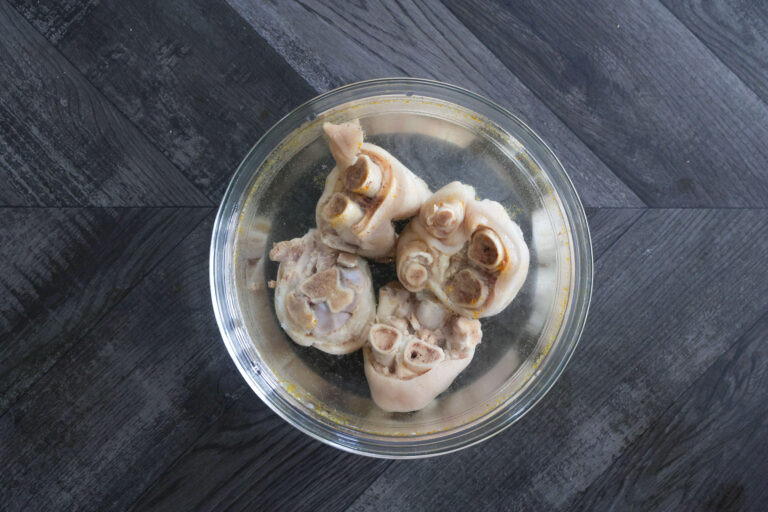
When the trotters and the beef shank are fully cooked, remove them from the stock and submerge in cold water bath, and put in the fridge.
The meats are ready when:
- The trotters are tender, but before they’re “fall off the bones” tender
- You pierce the beef shank and its juices run clear, not bloody
The cold water bath helps stop the cooking process and helps the trotters retain their milky colour. If you let them cool in the air, they’ll turn darker.
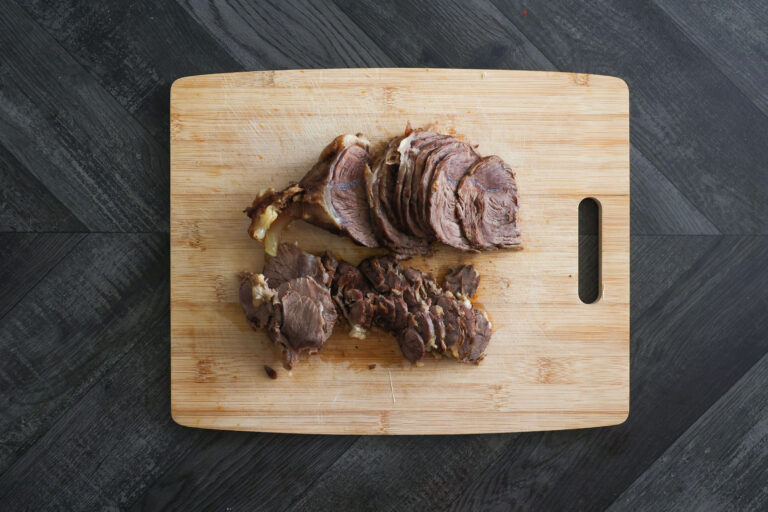
When the shank is completely cold, remove from the bath and slice against the grain (usually crosswise), as thinly as you can. I like to aim for an approximate ⅛ inch thickness. Set aside for final dish assembly.
Let broth simmer for at least 3 more hours.
PART 2: MAKE SATE SAUCE
STEP 6: Make sauce the last few minutes of cooking, for an added kick of fresh lemongrass.
Peel the outer layers off 2 lemongrass stalks, crush with the back of a knife, and set aside to add to the broth right before it’s done, for an extra kick of lemongrass.
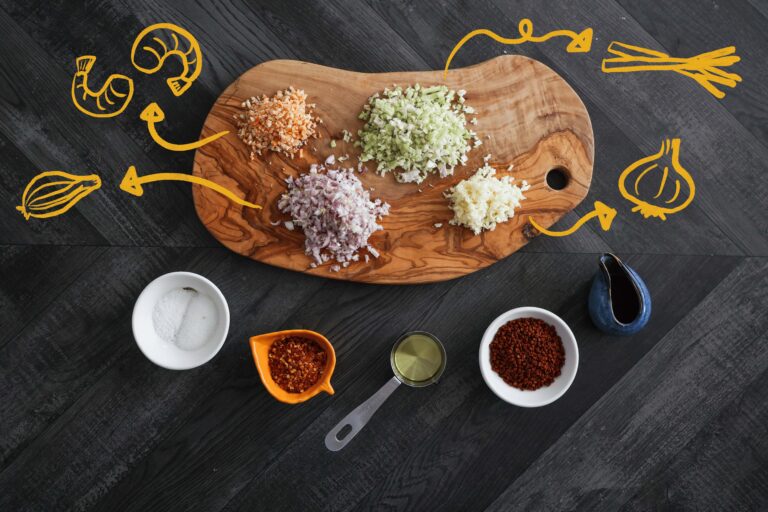
Mince the 2 inner stalks of lemongrass, 3 tbsp dried shrimp, 3 cloves garlic, and 3 shallots.
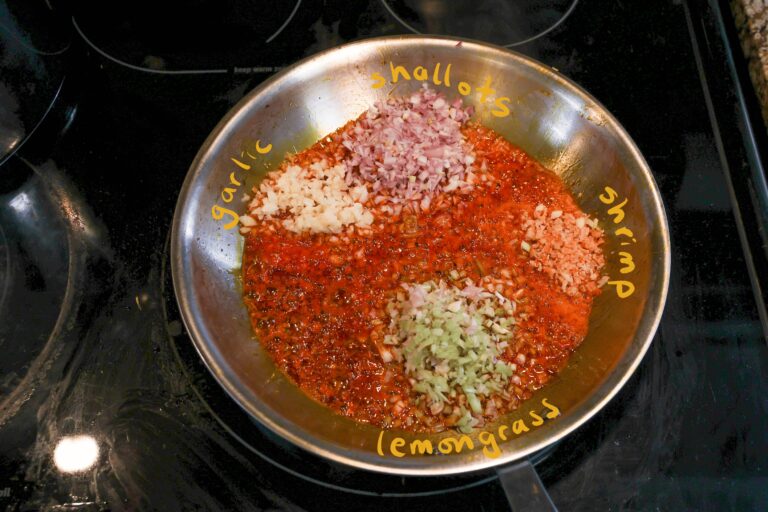
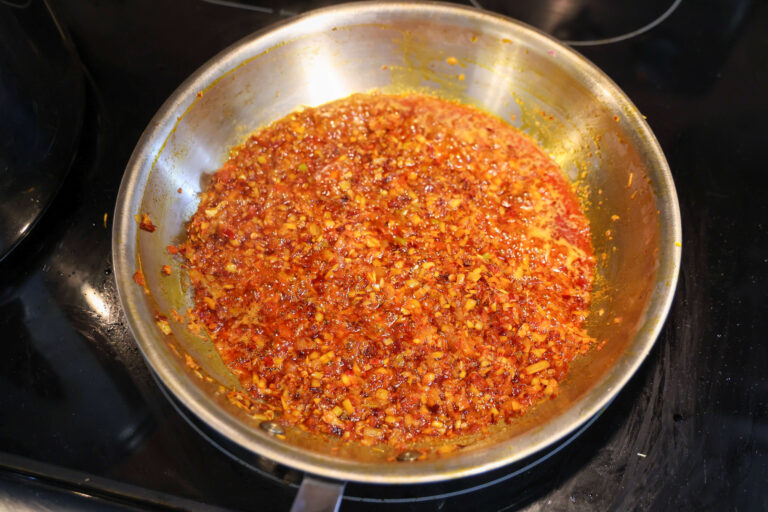
In a small pan over medium heat, add all the reserved annatto oil we made in Step 3. Add minced lemongrass, dried shrimp, garlic, and shallots. Add 2-4 tbsp pepper flakes, adjusting to your spice preference. Saute for 3 minutes, or until garlic is light gold and the mixture is very fragrant. Add ½ tbsp sugar, 1 tsp salt, and 2 tbsp fish sauce. Saute for another 3 minutes, or until the sauce thickens. Remove from heat.
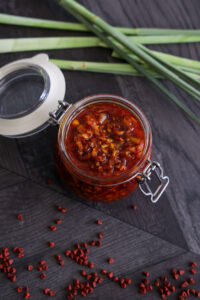
Homemade sate sauce. I think it’s much better than store bought. but it’s possible I’ve just been buying the wrong brand. For those in the know, please comment on what brand you like best. My hands are tired from all this mincing.
On Batch Making Sate Sauce
With all the ingredient gathering and mincing, sate sauce isn’t the easiest to make. I suggest doubling or tripling the recipe, using some for this bun bo hue recipe, and storing the rest in an airtight container. Sate sauce should keep at least 1 month in the fridge and 3 months in the freezer.
PART 3: FINISH AND SERVE
STEP 7: Cook noodles
Around 30 minutes before your broth is done, cook your 1.5lb of dried rice noodles according to the package’s instructions.
When noodles are done, immediately drain the water and submerge the noodles in an ice bath to stop the cooking process. Once noodles are completely cool, drain.
How to Cook Rice Noodles
If your rice noodle package doesn’t come with cooking instructions, or if they’re in an inscrutable language, here’s a foolproof way to cook rice noodles.
Please note: these instructions are for thick, cylindrical rice noodles – roughly the size of thick spaghetti. Thin dried rice noodles may need half the time. Start taste testing around 4 or 5 minutes.
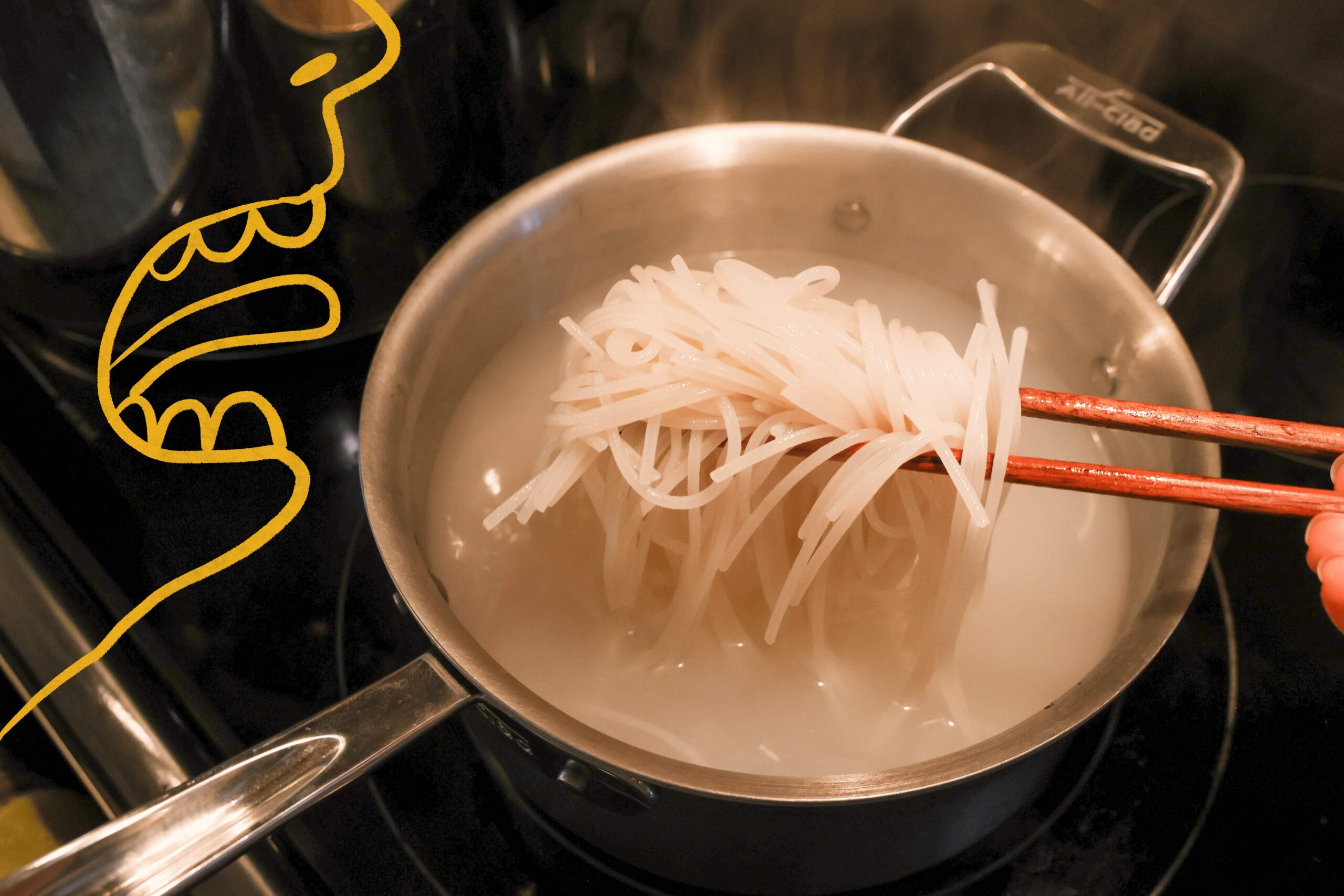
Fill a large pot with water and bring to a rolling boil over high heat. Add the noodles, reduce heat to medium-high, and cook noodles for 7 to 12 minutes. Always maintain a boil. Jostle noodles often to keep them from sticking together. Pour small amounts of cold water (e.g. ½ cups) as needed so the pot doesn’t boil over.
Now, this is the 1 part of bun bo hue where gentle hovering is encouraged. A lifetime of cooking rice noodles has taught me that they go from “the perfect chew” to “mush” in the blink of an eye.
Starting at the 7 minute mark, and every minute thereafter, take out a noodle and taste it for doneness. Noodles should be tender and chewy but not too soft. Err on the side of slightly undercooked.
STEP 8: Finish broth
While your noodles chill, it’s time to add the last flourishes to our broth!
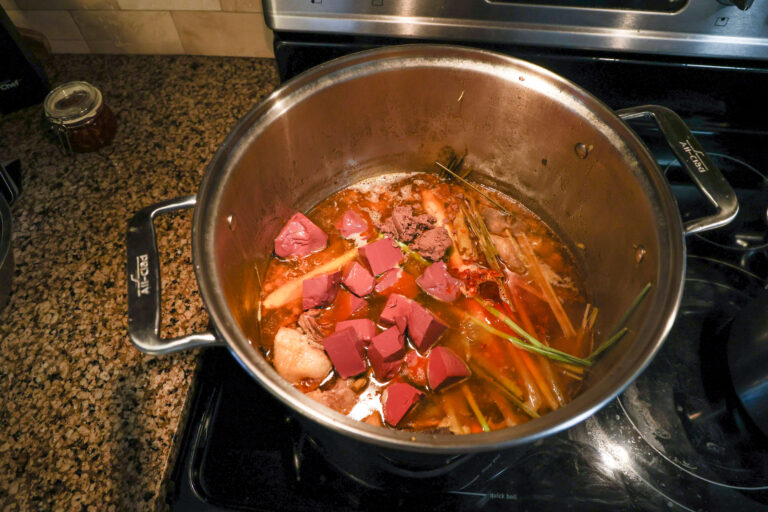
To your stockpot, add 1 lb of diced blood tofu (in 1 inch cubes), 2 tbsp fish sauce, ¼ cup of the sate sauce, the reserved crushed outer lemongrass stalks from the sate sauce, and 3 tbsp of shrimp paste (see NOTE).
Simmer stock for 5 more minutes, then turn off heat. Your broth is done!
NOTE: If you want to be fancy, you can mix the shrimp paste in a cup of hot water, let it rest about 10 minutes for the shrimp sediment to sink to the bottom of the cup, and scoop only the clear-ish shrimpy liquid to use in the stock. This will give you a clearer broth. However, if you, like me, did not think that this 5-hour-cooking-marathon needed any more fancy footwork, just chuck the paste right into the pot.
STEP 9: Assemble noodle bowls
Gather 8 extra-large serving bowls and divide noodles equally among bowls – around 2 cups of noodles per bowl.
Place on top of the noodles: 3-5 slices each of beef shank and Hue sausage, 1 pork trotter, 2-3 pieces of blood tofu. Ladle enough broth to cover everything.
STEP 10: Garnish and serve!
Serve noodles with extra sate sauce on the side, and a plate of your assorted herbs: a bunch of of cilantro, chopped, a bunch each of basil and mint (with large stems removed), 1 lb of bean sprouts, and 2 shredded banana flowers.
And finally, we eat.
Sip, slurp, and say “ahhh!”
3. FAQs
What are Annatto Seeds?
Annatto seeds come from the achiote plant, a shrub or small tree native to Mexico and countries in Central and South America. They have a distinct rusty red colour, and are shaped like small, dimpled pyramids. They have a slight earthy, nutty taste, and are used to flavour and colour dishes.
What is Blood Tofu?
Blood tofu is a traditional Chinese food made from animal blood. This is typically pig blood, but can also be chicken or duck blood (often at a premium). The blood is collected during the butchering process, mixed with salt water, and heated until it sets into a solid block, the consistency of soft tofu.
Blood tofu has a mild, earthy, and slightly metallic taste. Like real tofu, it’s a versatile ingredient that absorbs the flavours of whatever broth or dish it’s added to.
Blood tofu is amazing. It’s rich in iron (haha) and very high in protein. 100g of tofu has around 15g of protein, and 30-50 calories. That’s about the same calorie-to-protein ratio found in egg whites or skinless chicken breast – INCREDIBLE!
Which Bones are Best for Bun Bo Hue?
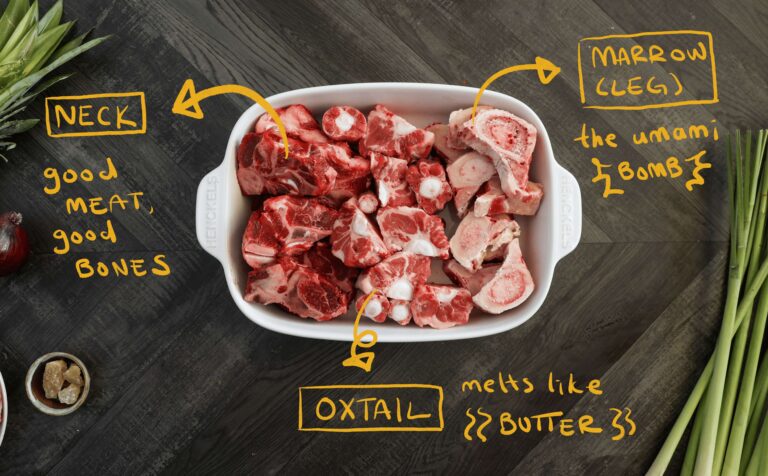
The best bones for bun bo hue is a combination of different types of bones, because they all have different strengths and add different qualities to your broth:
- Oxtail. If butter were a meat, it would be oxtail. Gently simmered oxtail is as smooth as velvet and just about melts in your mouth. However, and please don’t boo me for this – I don’t think it’s the be-all-end-all as an ingredient for stock. I find that oxtail alone may actually give you a “flat” tasting soup. Nonetheless, it’s a great part of a balanced stock. Oxtail should be cut crosswise into little pucks (or “medallions”).
- Marrow/leg bones. Marrow bones, or leg bones, are hollow bones with fatty yellow marrow on the inside. They release delicious fats while cooking, giving your stock a rich, silky quality. As with oxtail, too much of a good thing is a bad thing. Don’t use only marrow bones in your stock or it will come out too fatty. Marrow bones should be cut crosswise, to expose the marrow at both ends while keeping it relatively contained to slowly render into the stock.
- Knuckle bones. These are full of cartilage, tendons, and connective tissues – all of which pack a wallop of collagen, that when simmered breaks down to gelatin, giving stock its body. Don’t use knuckle bones alone in your stock, as they lack the meat to give stock its deep beef flavour. I did not have knuckle for this photoshoot.
- Neck bones. Like oxtail, neck bones have a good ratio of meat, bones, and connective tissue (great for collagen, which gives stock its body). Neck bones are also usually cheaper than oxtail, so they’re also an economical choice!
All bones should be cut by your grocer/butcher. You need to cut straight through bones, which is hard to impossible to do with kitchen knives.
4. Recipe Card
Bun Bo Hue
Equipment
- 1 Large stockpot (minimum 12 quarts) for broth
- 1 Small pan for sate sauce
- 1 Large pot for noodles
- 1 Fine mesh skimmer
Ingredients
Broth (Base)
- 2 lb beef shank
- 6 lb beef bones - mix of neck leg, neck, knuckle, and/or oxtail
- 2 lb front pork trotters quartered crosswise by the butcher
- Water
- 8 stalks lemongrass crushed and halved crosswise
- 1 onion halved
- ⅓ pineapple
- 2 tbsp rock sugar substitute granulated sugar
Broth (Finishing - for Step 8)
- 1 lb pork blood tofu diced into 1 inch cubes
- 2 tbsp fish sauce
- 3 tbsp fermented shrimp paste
- ¼ cup sate sauce from sate sauce recipe
- Reserved crushed lemongrass husks from sate sauce prep
Sate Sauce
- ½ cup neutral cooking oil e.g. canola, vegetable, peanut
- 4 tbsp annatto seeds
- 3 tbsp dried shrimp finely minced
- 2 stalks lemongrass hard exterior layers removed and crushed for broth, interior finely minced for sate sauce
- 3 cloves garlic finely minced
- 3 shallots finely minced
- 2-4 tbsp dried pepper flakes
- ½ tbsp sugar
- 1 tsp salt
- 2 tbsp fish sauce
Noodles and accompaniments
- 1.5 lb dry rice noodles cylindrical and round - around 2-3mm in diameter, roughly the size of thick spaghetti
- 1 lb store bought Hue pork sausage chả Huế, sliced thinly
- 2 banana flowers shredded
- 1 lb bean sprouts
- 1 bunch coriander chopped
- 1 bunch basil large stems removed
- 1 bunch mint large stems removed
Instructions
PART 1: START BROTH
- Parboil meats. Add 2lb beef shank, 6lb beef bones (mix of neck, leg, knuckle, and/or oxtail), and 2lb pork front rotters (quartered crosswise) to stockpot and fill with just enough water to cover everything. Bring to a boil over high heat and boil for 10 minutes. Jostle meat occasionally to help dislodge impurities. Remove from heat and discard water. Rinse meat and stockpot to remove any visible impurities.
- Boil stock. Place meat and bones back into cleaned stockpot and add enough water to just cover everything. Add 2 tbsp rock sugar and ⅓ a pineapple. Bring everything to a boil, then reduce to simmer until the trotters are tender and beef shank is fully cooked - around 1 to 1.5 hours. For first 10 minutes of simmer, skim top of soup with fine mesh skimmer to catch remaining impurities, and discard.
- Make annatto oil. While the stock simmers, make annatto oil. On medium heat, heat ½ cup oil in small pan. Add 4 tbsp annatto seeds and saute for 2 minutes or until oil is dark red. Discard annatto seeds and spoon all but 1 tbsp of annatto oil into a bowl for the sate sauce.
- Toast aromatics. Heat pan with remaining annotto oil on medium heat, add 8 stalks crushed and halved lemongrass and 1 halved yellow onion. Stir occasionally. Toast until fragrant and onion is slightly browned, around 3 minutes. Add toasted lemongrass and onion to stock, and continue simmering stock per Step 2.
- Remove trotters and shank. When trotters and shank are fully cooked (trotters should be tender but not fall-off-the-bones; shank should run clear juices when pierced), remove both from broth, and submerge in cold water bath to preserve the whiteness and bouncy texture. When shank is completely cooled, slice thinly across the grain, and set aside for final soup assembly. Let broth simmer for at least 3 more hours. If simmering more than 3 hours and using oxtail as part (not all) of the bones, remove oxtail only at hour 3 to not overcook it.
PART 2: MAKE SATE SAUCE
- Make sate sauce. Peel the outer layers off 2 lemongrass stalks, crush with the back of a knife, and set aside for later. Heat reserved annatto oil in small pan over medium heat. Add minced: 2 inner stalks of lemongrass, 3 tbsp dried shrimp, 3 cloves garlic, and 3 shallots. Add 2-4 tbsp pepper flakes. Saute for 3 minutes, or until garlic is light gold and mixture is very fragrant. Add ½ tbsp sugar, 1 tsp salt, and 2 tbsp fish sauce. Saute for another 3 minutes, or until the sauce thickens. Remove from heat.
PART 3: FINISH AND SERVE
- Cook noodles. 30 minutes before the broth is done, cook 1.5 lb dry rice noodles according to package instructions, then strain and transfer to cold water bath. Drain when noodles are completely cool.
- Finish broth. Add 1 lb diced blood tofu, 2 tbsp fish sauce, reserved crushed outer lemongrass layers, ¼ cup of sate sauce, and 3 tbsp shrimp paste. (For clearer broth, mix shrimp paste with 1 cup hot water. Let sit for 10 minutes for dregs to settle to the bottom. Ladle the clear liquid from the top, and add only the clear liquid to the broth.) Simmer for 5 minutes, then turn off heat.
- Assemble noodle bowls. Drain noodles and divide among 8 large serving bowls (around 2 cups of cooked noodles per bowl). Add 3-5 slices each of beef shank and Hue sausage, 1 pork trotter, and 2-3 pieces of cooked blood tofu. Ladle broth to cover everything.
- Garnish and serve! Serve noodles with extra sate sauce on the side, and a plate of 1 bunch each of cilantro (chopped) and basil and mint (tough stems discarded), 1 lb bean sprouts, and 2 shredded banana flowers. Sip, slurp, and say “ahhh!”
